Co-occurrence Analysis
Embodiment & Violence
40 games in dataset
Embodiment and Violence in Outlast 2
In Outlast 2, the co-occurrence of embodiment × violence in the dataset presents the female body as explicitly the contested object over which religious, institutional, and patriarchal violence is organized.
The game establishes this immediately under the premise: a pregnant teenager, identified only as “Jane Doe,” has been murdered. She has no name, only a bodily condition. Cult leader Sullivan Knoth rapes local women and, once pregnant, executes them on suspicion that the women may be carrying the Antichrist. A breakaway faction, the Heretics, oppose Knoth not on moral grounds but on theological ones: where Knoth seeks to prevent the Antichrist’s birth, the Heretics seek to witness it to quicken Judgment Day. Both factions share identical premises about what a pregnant woman’s body contains and differ only on what should be done with it.
This dynamic can be understood through Barbara Creed’s argument in The Monstrous-Feminine: Film, Feminism, Psychoanalysis (1993) that patriarchal ideology constructs women as monstrous, specifically in relation to their reproductive bodies, in order to justify their subjugation. In Outlast 2, the pregnant body is not simply feared, but it is controlled and destroyed by competing patriarchal institutions precisely because its reproductive capacity has been coded as dangerous. It is worth noting that, while this analysis is currently coded under the embodiment × violence co-occurrence, the game’s strong theme of pregnancy also intersects with this project’s pregnancy theme co-occurrences. The two co-occurrences are genuinely inseparable in Outlast 2, and this game demonstrates how the paired theme groupings frequently intersect across a third or fourth axis. The pregnant body here is not incidental to the violence, but it is the justification for the violence.
Lynn Langermann, over the course of the game, is a prime example of “person-to-body”. The player experiences her story through the perspective of Blake Langermann, a cameraman and Lynn’s husband, who is searching for her after the two are separated in a helicopter crash. She begins as a journalist with a purpose and ends as a vessel used entirely by two competing patriarchal factions. She is progressively stripped of subjectivity as competing factions fight over her reproductive body. She is held by Knoth’s cult, kidnapped by the Heretics, and ultimately dies in childbirth, having moved through the narrative less as a character and more as a body passing between institutions. To add a further layer of complexity, the game’s lore implies that Lynn’s pregnancy may itself be a hallucination produced by Murkoff Corporation’s mind control technology, which means the bodily condition that made her a target may never have been real. The body is both real and constructed, both violated and imagined.
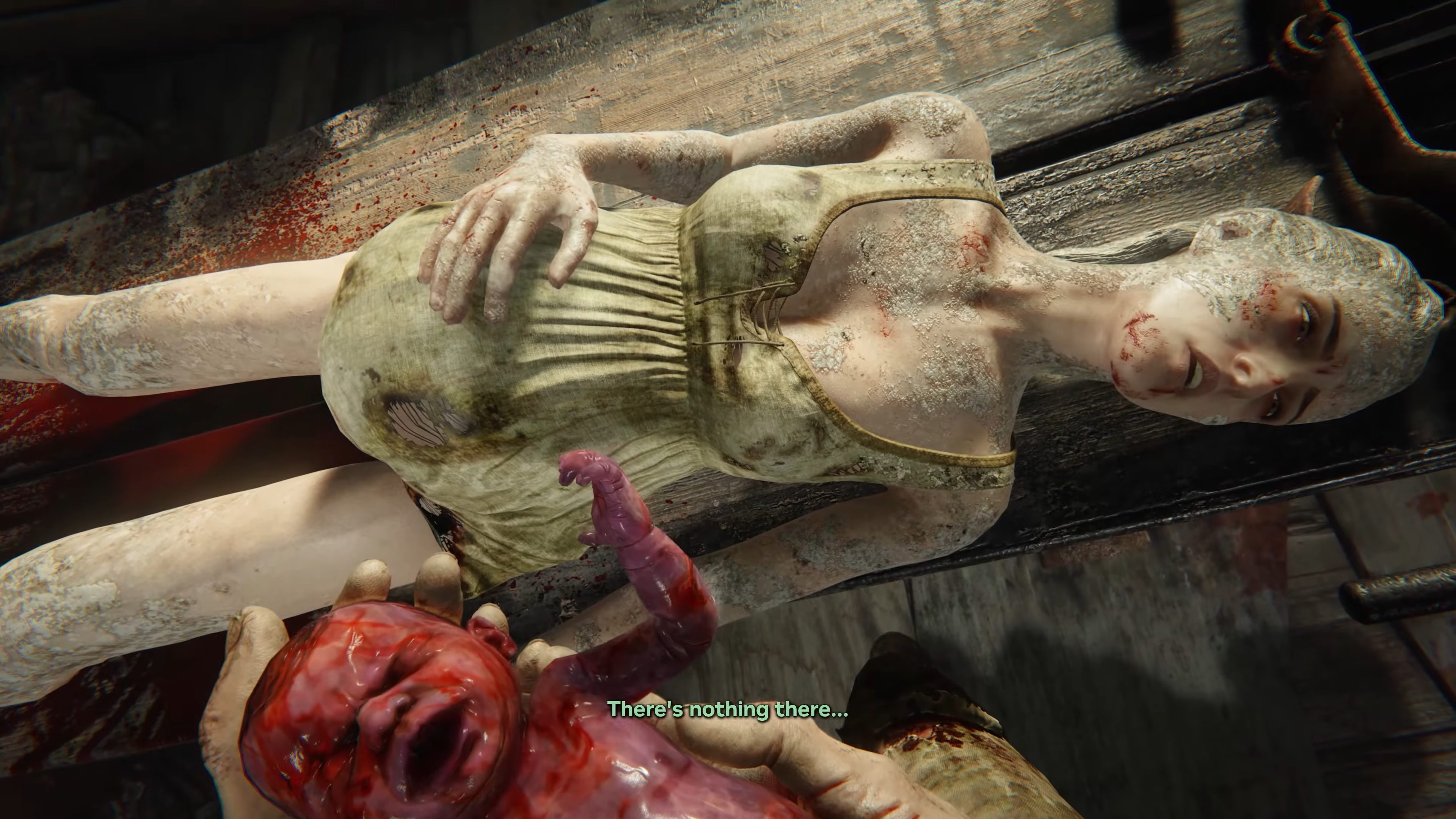
The game’s other significant female figures extend the co-occurrence in different directions. Marta, a cult member who was ideologically conditioned into violence and is an enforcer wielding a pickaxe, represents embodied violence weaponized on behalf of patriarchal religious authority. She’s a woman whose body has been made into an instrument of the very institution that controls her. Her body is rendered monstrous rather than human: she is enormous, relentless, and defined entirely by her ability to inflict harm. Ultimately, Marta dies impaled on a fallen cross, and her body is returned, literally, to the structure she served. She is a figure that falls into Creed’s frameworks, which identifies the monstrous-feminine as a construction in which femininity itself is rendered monstrous by patriarchal ideology. Marta’s monstrousness is not intrinsic, and the lore establishes that she was initially reluctant to kill and was gradually shaped by Knoth into his executioner. Jessica Gray operates differently: she was sexually violated and murdered by a priest, her death covered up and reframed as suicide. Her body is absent from the game’s present tense, existing only as recovered memories surfacing through Blake’s hallucinations.
Across all four figures: Jane Doe, Lynn, Marta, and Jessica, Outlast 2 constructs a world in which the female body is an object of violence. In each case, the co-occurrence of embodiment and violence defines the game’s concept as a whole. The female body in Outlast 2 is only ever made visible at the moment it is acted upon, murdered, impregnated, weaponized, violated, or erased. Embodiment and violence do not simply appear together in this game; they produce each other. No female character retains sovereignty over her own body, and that consistency is not accidental, but it is the game’s central horror logic. What Outlast 2 ultimately demonstrates for this project is that embodiment × violence is not a theme that appears in the game but the structural principle through which the entire narrative is organized. The female body is not where the horror happens to land; it is the terrain the horror is built on.