Co-occurrence Analysis
Embodiment & Motherhood
30 games in dataset
Embodiment and Motherhood in Bloodborne: The Failed Mothers of Yharnam
Parents can be terrifying. As children, we are both dependent on them and at their mercy. Mothers in particular exemplify this anxiety. Typically it is the mother who is the most physically connected to her baby (I say “typically” because trans men and nonbinary people can also give birth. But for the purposes of literary symbolism, this role is firmly associated with the mother, so that is what I will focus on here). Through the umbilical cord, mother and child’s bodies are physically linked together, and only when that cord is cut does the child become an individual living person. “Before you’re born” and “after you’re dead” both mean you don’t exist, which makes birth and death the two bridges between life and oblivion. Mothers and depictions of birth in horror express this terror of oblivion in different ways, as Barbara Creed explores via the archetypes she describes in her book The Monstrous Feminine. The “Archaic Mother” archetypes seek to propagate, even by re-incorporating their children into themselves, the “Monstrous Wombs” spawn monstrous children, and the “Castrating Mothers” suppress their children’s agency by using them as tools.
The horror action RPG Bloodborne, released in 2015 and developed by FromSoftware, takes this anxiety and pushes it up to 1000, by weaving symbols of femininity and motherhood into visceral depictions of embodied horror. You play as a Hunter in the city of Yharnam, a fantastical version of Victorian London plagued by an illness that transforms humans into beasts. Your job is to kill these beasts and piece together what exactly is happening in the city. The setting is also full of monstrous eldritch beings - the Great Ones - who watch and manipulate events, unable to even be perceived by ordinary humans. In addition, the game repeatedly frames pregnancy and birth - or the inability to successfully give birth - as their own types of body horror. At the end of the game, the player is given the choice to be born anew and take on a type of divine motherhood themself, inviting players to hope that perhaps even a child shaped by the most awful aspects of motherhood can do better as a mother figure.
In keeping with their archaic existence, the Great Ones are alluded to long before you can even see them, let alone fight them. Their role as ancient and obscure gods already fits Creed’s formulation of Archaic Mother as “primordial abyss, the point of origin and of end” (Creed 79). And the concept of failed motherhood is emphasized even in small tidbits of lore you get about them. The item description for three mysterious umbilical cords you can find throughout the game says: “every Great One loses its child, and then yearns for a surrogate.” Other in-game text implies that Great Ones attempted to overcome this limitation by bestowing onto chosen humans a “ring of betrothal” given “to those slated to bear a special child.” This could frame the Great Ones as divine fathers seeking human mothers. But the use of the word “surrogate” to describe the human childbearers, rather than “wife” or “mother” frame the Great Ones not as the fathers, but as the mothers, who simply need another party to carry their child. In this case, the surrogate, despite bearing a child, is symbolically a child themself compared to Great Ones with all their age and power, used as a tool to support the Great Ones’ motherly ambitions and cementing them as incapable of motherhood on their own.
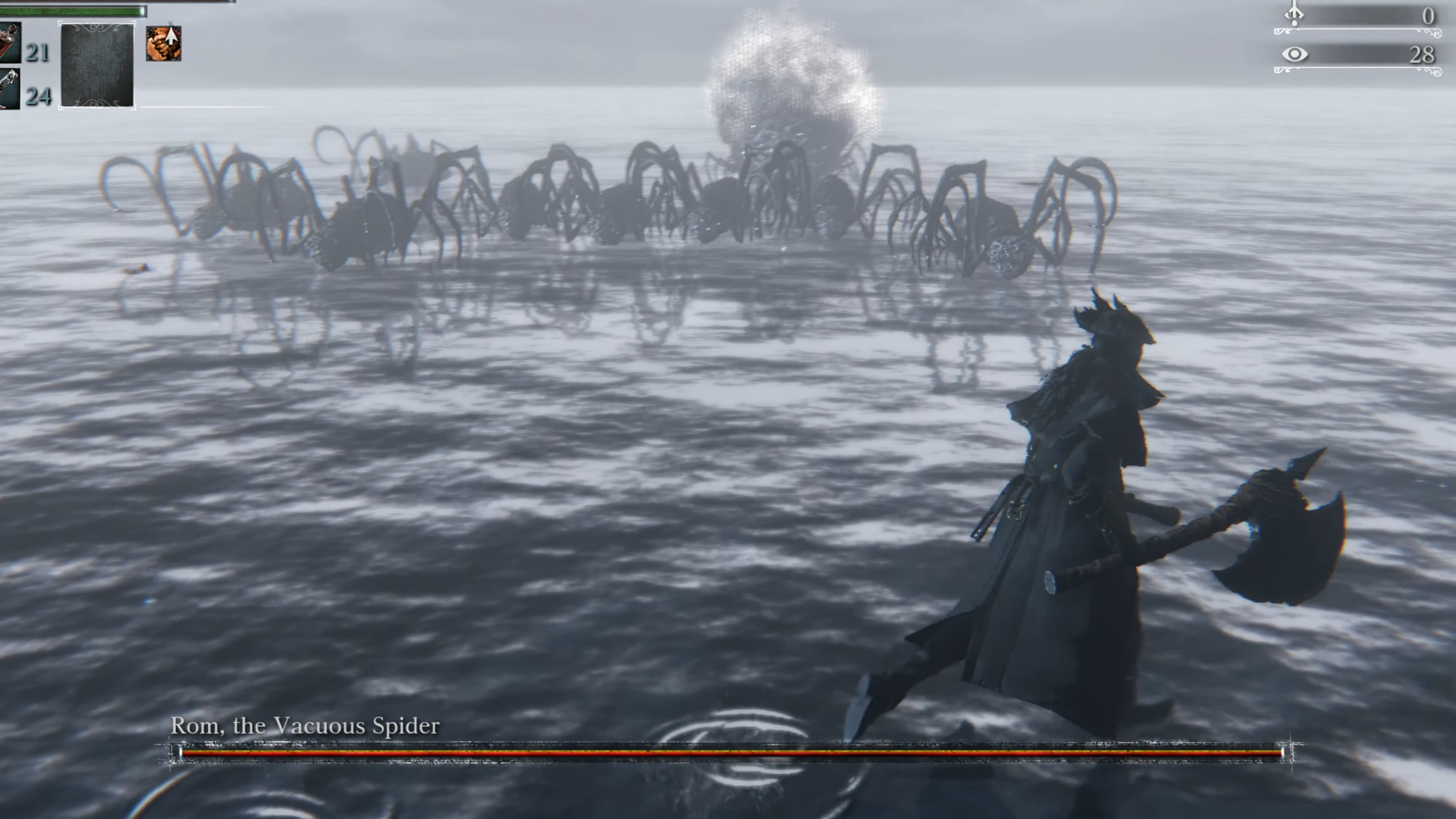
The Great Ones haunt the setting and add to its disturbing atmosphere from the background, but one of the player’s first direct brushes with them comes with Rom, a grotesque arachnid creature. She is described as a Great One by some in-game text but also doesn’t appear to have as much agency as Great Ones we meet later. While we aren’t told much about her character, the mechanics of her boss fight put the threat of motherhood into action. In the beginning of her battle, Rom doesn’t even directly attack. Instead, it is her spider offspring that fight you, defending their mother. Unlike the other Great Ones, Rom has no problem giving birth to smaller spiders with no need for a father or surrogate. However, the game still depicts her as a failure. Her boss title is “Rom, the Vacuous Spider”, she is concealed in a lake, and she appears unable to communicate. Together, these factors frame her as an embarrassment - despite her success at being a mother in both the literal sense of producing children, and the metaphorical sense of Great One taking the role of Archaic Mother, she is still seen as “vacuous” and is hidden away. In this way, Rom represents two sides of the terror of motherhood. As an enemy, she inspires the terror of facing down a mother as Monstrous Womb, a wellspring of seemingly infinite life. But as a sympathetic character in her own right, Rom also represents the terror of being belittled and physically affected as a mother. This terror is exaggerated in that her body is that of a monstrous spider, but her lack of bodily autonomy and diminishment by her peers is clear all the same.
Arachnophobia warning: Click here for an image of the Rom battle if you don't mind seeing realistic looking spiders.
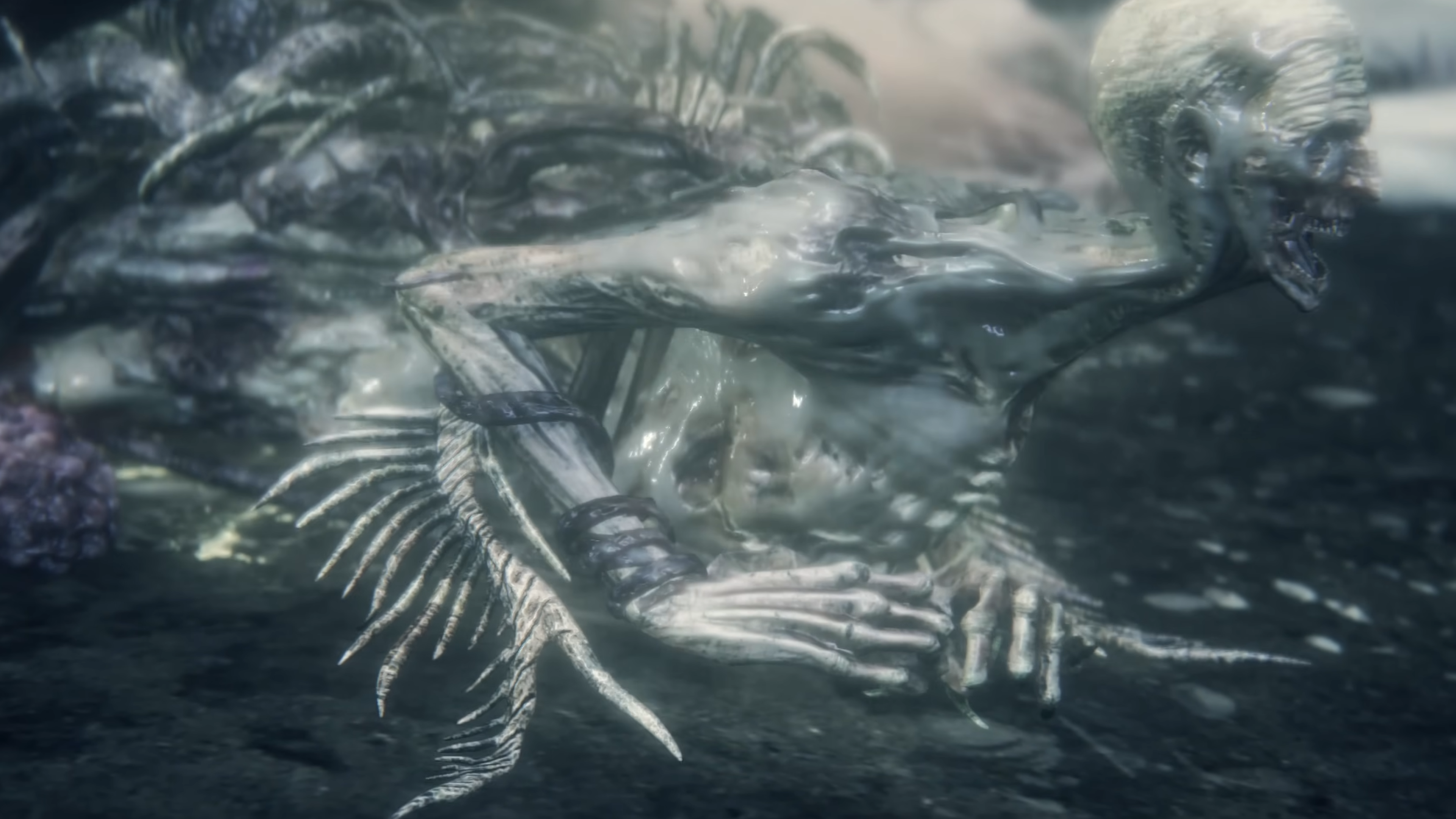
One of the most blatant mother figures in Bloodborne is Kos, a Great One who resides in the ocean, and who much of the game’s DLC centers around. Kos is already dead long before the game begins, but after a team of researchers disturb her corpse and kill the villagers who worshipped her nearby, a terrible curse befalls them, trapping them in an endless Nightmare. Eventually the protagonist has to fight Kos’s child, identified only as “the Orphan of Kos”, who has been maintaining the Nightmare as well as Kos’s grudges. Throughout the DLC, we hear chants and prayers of denizens of the Nightmare. Some chants, like “Mother is dead, her baby, taken. Scales are suffering, the grief of Kos” paint Kos as a sympathetic mother who endured the awful fate of being unable to care for her child. Others take a different view: “A bottomless curse, a bottomless sea, source of all greatness, all things that be. Listen for the baneful chants. Weep with them, as one in trance. And weep with us, oh, weep with us…”. This invitation to meld into the chant is less tragic and more unsettling. In addition, the fact that Kos’s child is not given a name besides “Orphan of Kos”, which clearly marks the child as belonging to their mother before anything else, and the fact that we meet the Orphan crawling out of their mother’s dead body, further emphasizes Kos’s ability to influence the world as a mother, even through her own child, as Creed describes with the Castrating Mother archetype. Mothers of all sorts face similar challenges to Kos - the risk of dying during birth, and the risk of not being able to be there for your child - which gives Kos some humanity, even as a horrific sea god. But it is those same aspects of her that also trigger fear. Her grudge against those who hurt her and her child is so strong that even after her death it persists through that child, consuming and terrorizing people. Fear of Kos reflects a fear of a mother’s revenge - while Rom is in a mindless survival mode simply trying to defend herself when attacked, Kos knows exactly who hurt her and how to hurt them back. No matter who we relate to in this situation, the mother, the child, or the victims of the nightmare, these roles all both suffer from and inflict terror and tragedy. In a world where mothers are made into monsters, nobody wins.
At the end of the game, the player character is given an offer by Gehrman, a man who guides hunters like the protagonist from a dream world, to sever their connection to the bloody hunt they’ve undertaken and live a normal life - the Yharnam Sunrise ending. If you refuse, Gehrman will fight you, and on defeating him you will take his place, becoming trapped in the dream world and blessed by the Moon Presence, the Great One who oversees it - the Honoring Wishes ending. But if you happen to have eaten the three umbilical cords of the Great Ones, after refusing and then defeating Gehrman, the player character is able to resist the Moon Presence, and upon defeating her, is transformed into a squidlike infant Great One themself. Additionally, the message given to the player upon winning this final battle is a unique one (only shared with defeating the Orphan of Kos to finish the DLC): “NIGHTMARE SLAIN”. This ending then, is infused with a sense of hope despite it making the most drastic mark on the protagonist’s body. While nearly every other instance of body horror in the game is inflicted on the subject against their will, this one is chosen by the protagonist through their actions, and it grants them freedom rather than subjugating them. In this ending alone is the Moon Presence pulling many of this world’s strings defeated. In this ending alone does the nightmare truly end.
It is also full of symbols of both motherhood and childhood. The ending is called “Childhood’s Beginning” and the protagonist is reborn as a baby version of the god they just defeated, picked up like a child by the kind Doll in the dream. But at the same time, the protagonist consumed pieces of an umbilical cord, something that resides inside the mother as she carries a child, and is implied to have replaced the mother-like Moon Presence (in a parallel to their replacement of the father-like Gehrman in the Honoring Wishes ending). In her discussion of the Monstrous Womb archetype, Creed discusses how some fantastical and horrific births can bring to mind the impossible idea of giving birth to oneself, saying: “The subject who phantasises about giving birth to himself does so in order to cut his tie to the mother” (Creed 187). Becoming both mother and child, then, is an assertion of independence. By playing the role of mother, you are able to become the mother you wish you had, healing the damage she has inflicted on you, and breaking her hold over you. And by playing the role of child at the same time, you are able to start over with a clean slate with those influences wiped clean, replaced with your own motherly nurturing of yourself. It is the final end of the protagonist’s harrowing experience, paired with the taste of motherhood-as-power they gain in only this ending, that makes Childhood’s Beginning hopeful.
If even becoming a grotesque squidlike creature can be a happy ending, it’s worth rethinking whether the more human process of birth and motherhood is in fact as horrifying as we think. Parents are always going to mess their kids up somehow. But being a mother isn’t more “unclean” than anything else, especially in a world like Bloodborne’s, filled with blood and decay. And good mothers - good parents in general - can learn from the inevitable failures, and try to heal their mistakes instead of becoming stuck in a cycle of horror and violence like the many failed mothers in Bloodborne.